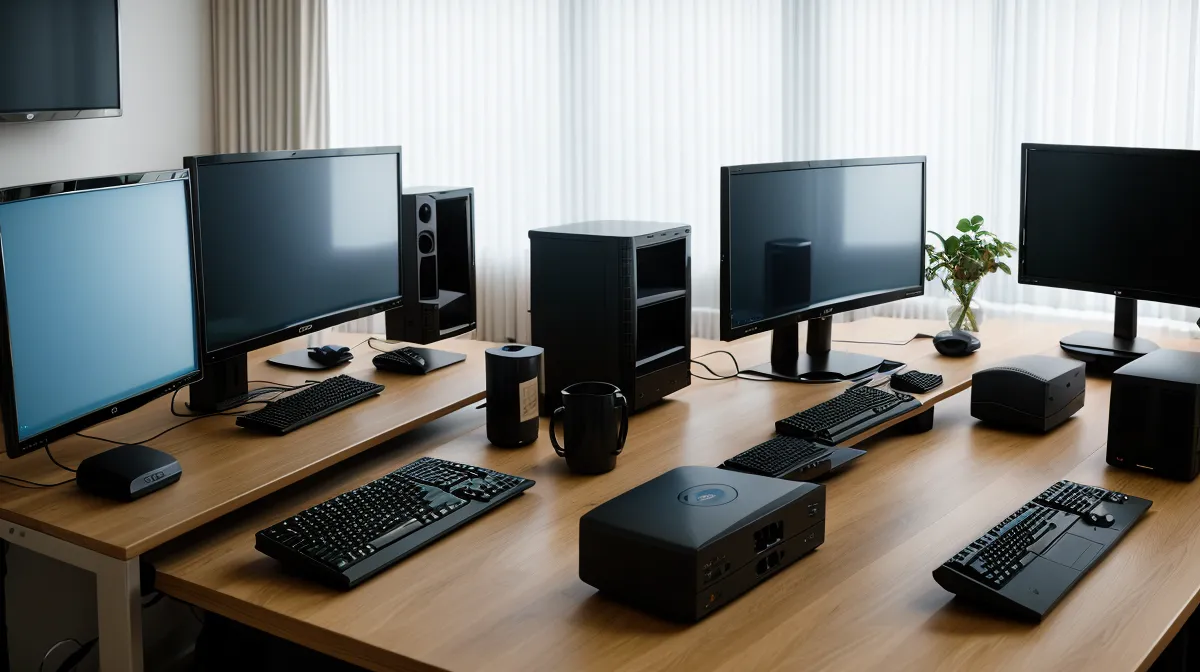
Seven bottles of eye supplements sat on my kitchen counter before I'd admit that blue light glasses, on their own, weren't solving anything. Each one got its own line in a tracking spreadsheet — capsule count, when I took it, how gritty my eyes felt by the end of a coding session, roughly what it cost me each month. The habit started because of a dull ache that liked to show up right behind my eyebrow during afternoon code reviews, usually while my test suite was still crawling across all three of my monitors and my cursor had turned into a fuzzy white smear I couldn't quite focus on.
Quick disclosure before any of the supplement talk: this article contains affiliate links, and if you buy through one I earn a commission at no extra cost to you — I only write about eye supplements I've actually swallowed and tracked myself. If your eyes are doing the same thing mine were, VisiFlora's current direct formula is the one I still reach for, and I'll explain why below.
What a Normal Eye Exam Looked Like

My optometrist's take surprised me. I went in expecting a new prescription, and instead she ran through the usual phoropter checks and told me my baseline vision hadn't moved at all. This was straightforward digital eye strain, the kind some people call asthenopia, caused by staring at a screen too long without enough breaks. She didn't go deep into the biology of it, and honestly neither will I; I'm not qualified to explain what's happening at a cellular level, only to report what I noticed.
Before any supplement entered the picture, I'd already tried the cheapest fix available — a bottle of preservative-heavy drugstore eye drops, reapplied on the hour, pretty much every hour I was at my desk. It bought me maybe twenty minutes of relief before the grit crept back in, and going through a bottle a week isn't exactly a sustainable system. That failure is what pushed me toward something closer to how I'd debug an actual production issue: track the variable, change one thing at a time, write down what happens.
Treating my own eyes like a system under test probably sounds excessive, and look, I'll admit the irony of a guy who ruins his eyesight for a living trying to engineer his way out of it. But a spreadsheet with one row per day, tracking which supplement, what dose, and a rough one-to-ten strain score by the late afternoon, was the only way I trusted my own notes more than vague gut feelings. Over about fourteen months I ran that experiment across seven different products, and three of them are worth actually talking about.
Starting Cheap: Testing TheyaVue's Catch-All Formula
TheyaVue was the first one I bought, mostly because the label listed 24 different ingredients and I figured more coverage couldn't hurt. It read like a dependency file where someone imported every utility package just in case one came in handy eventually — antioxidants, common vitamins, a handful of botanical extracts, all bundled into two capsules a day.
Four weeks in, the afternoon fatigue had dulled slightly, but the dry, gritty feeling after dark never fully went away. Spreading 24 ingredients across two capsules means every individual dose is thin, and thin doses didn't do much for someone staring at three screens for most of a workday. It's a reasonable starting point if you're testing the waters on a budget, and I actually wrote up the full framework I used to track it in my tracking notes on testing eye supplements without guesswork — but as a daily driver, it wasn't enough on its own.
Did Narrowing the List Help? iGenics and Its 12 Ingredients
Next came iGenics, which takes the opposite approach — 12 ingredients instead of 24, leaning hard on lutein, zeaxanthin, and a few herbal extracts rather than trying to cover every base at once.
Somewhere in the middle of a tedious database migration, split across two of my three monitors, I noticed the usual brow tension wasn't showing up the way it had the month before. A narrower formula apparently hits harder than a scattershot one, at least for me. The capsules themselves are big enough that I needed a full glass of water to get one down with my morning coffee, and it took a few solid weeks before I'd call the improvement reliable rather than a lucky day. Good supplement, mediocre patience test.
The Shift That Actually Stuck: VisiFlora at Week Seven
By the time I switched to VisiFlora, I'd stopped expecting any single bottle to fix three-monitor fatigue completely. Its pitch is different from the other two — instead of just loading up on carotenoids, it treats gut health as part of the same system as eye comfort, which sounded like a stretch until I actually gave it a real run.
One capsule a day, taken with breakfast, turned out to be the detail that mattered most — not having to remember a second or third dose mid-workday removed a surprising amount of friction. Around the seventh week, during a Friday standup where I was pointing at a whiteboard full of sprint notes, I realized I'd read the whole board edge to edge without losing my place or squinting halfway through. That's a small thing, but it was the first time in over a year that a screen-adjacent task didn't register as effort.
My college friend Dex Harrington, who went fully remote a couple of years ago, texted me not long after asking for whatever I'd figured out — he wanted it in two bullet points, not a link to my spreadsheet, which is a fair response to fourteen months of obsessive tracking. I told him the short version: one capsule, taken consistently, mattered more than which exact ingredient list he picked. Luciana Ferber, a product manager I used to collaborate with on contract work, is about as pragmatic about self-care as anyone I know — she only ever adopts a new habit if it slots into a schedule that's already full, and a single daily capsule was the one eye supplement idea she actually kept past the first week.
On one particularly bad glare afternoon, I packed up my laptop and worked from a coffee shop along the South Congress Avenue strip instead, just to put real daylight between my eyes and three LED panels for a few hours. It helped, but it's not a long-term plan when deployment deadlines don't care where you're sitting. Most nights, by the time Austin actually went dark outside, the only light nearby was the cold blue-white wash bouncing off the ceiling from all three screens — a strange way to realize how much of your day is lit by a monitor and not the sun. VisiFlora backs its orders with a 60-day money-back guarantee, which took some of the sting out of ordering directly from their site at a price that sits well above the budget options. For the longer version of these fourteen months, I laid it all out in what triple-monitor fatigue taught me about eye stacks.
Why I Still Think Ergonomics Beats Any Capsule Long-Term

Tracking three supplements across more than a year surfaced an uncomfortable pattern: every capsule is a recurring line item, forever, as long as you keep taking it. None of them are a one-time fix the way adjusting your actual desk setup can be.
It's the same trade-off as patching a slow database query by throwing more server capacity at it every month versus just fixing the query once. Raising monitor height to eye level, matching room lighting to screen brightness, and actually taking a short break every twenty minutes or so are changes you make once and keep for free afterward. Supplements, in my experience, work best as a buffer during the weeks when a contract has you glued to the keyboard twelve hours a day — not as a replacement for fixing the desk itself. I went into more of that comparison in why screen brightness adjustments need more than just software.
My Honest Ranking After Fourteen Months of Tracking
If you want the cheapest way to find out whether eye supplements do anything for you at all, TheyaVue's 24-ingredient formula is a reasonable place to start. If you don't mind bigger capsules and some patience, iGenics' narrower 12-ingredient approach held up better for me over time.
For anyone staring down three monitors for a living who wants the lowest-friction daily habit, VisiFlora is still the one sitting on my desk. One capsule, one guarantee window, and noticeably less grit by the time my afternoon stand-ups roll around. Check current availability on their site, fix your monitor height while you're at it, and give your eyes a fighting chance before your next deployment.
| Product | Rating | |
|---|---|---|
| VisiFlora Top Pick | 9.1 | Read More → |
| iGenics | 8.4 | Read More → |
| TheyaVue | 7.8 | Read More → |
VisiFlora
Pros
- ✔ Targets both gut and eye health connection
- ✔ Streamlined one-capsule daily dose fits busy workdays
- ✔ Official 60-day money-back guarantee window
- ✔ Helped ease gritty late-afternoon screen fatigue
Cons
- ○ Premium pricing compared to entry-level blends
- ○ Only available via their official website