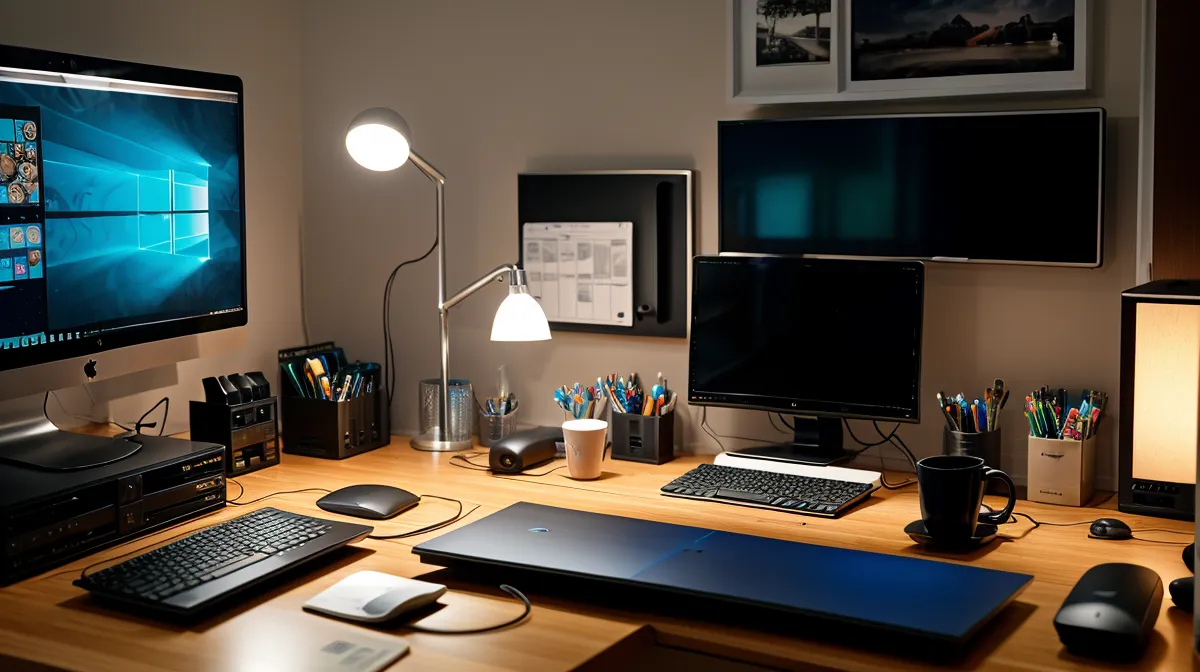
A tired eye and a dry eye feel almost identical from across a desk, but they are not the same problem, and for months I treated them like they were.
That confusion is basically the whole story of digital eye strain for anyone doing remote work behind a wall of monitors: several different failures announce themselves as the same dull ache, and no single eye care routine fixes all of them at once. Screen recovery, in my case, turned into something closer to debugging than self-care. Isolate the actual failure before you patch it.
A friend of mine spends his weekends brewing craft IPAs in his garage, logging temperatures and times for every batch like it's a lab experiment. I do roughly the same thing with my eyes, except the log is a rough strain score instead of a hop schedule, and the batch is whatever client work filled my screen that day.
People who read this site send me more or less the same handful of questions, so instead of another narrative walkthrough, here they are, answered as directly as I can.
Tired Eyes and Dry Eyes Are Not the Same Bug
Dry eye and eye fatigue get lumped together constantly, but they ask for different fixes — dryness is a tear-film problem that shows up as grit and burning, fatigue is more of a deep pull behind the eyebrows after too long holding focus at one distance. A third thing, plain mental fog from too many hours of screen time, mimics both and has nothing to do with your eyes at all. My rule of thumb: if blinking hard and looking away for a minute doesn't help, it's probably not dryness talking. I keep a longer breakdown of how to spot the actual signs in my notes on Common Signs of Digital Eye Strain and My Favorite Supplement Stack.
How the 20-20-20 Rule Works
The 20-20-20 rule — every 20 minutes, look at something 20 feet away for 20 seconds — is the eye-rest advice everyone repeats, and it's a reasonable baseline if your eyes aren't already in bad shape. Mine were, by the time I tried it seriously, and jumping straight from a close-up diff to a distant fence post sometimes made the ache worse instead of better, because the focusing muscle gets asked to snap from one extreme straight to the other with no transition. What worked better for me was adding a soft middle step, unfocusing on something mid-distance, like the far wall, before trying to lock onto anything far away. If the standard version isn't moving your numbers, that transition step is worth testing before you give up on rest breaks entirely.
What Blue Light Glasses Actually Do
For me, no. The pair of cheap clip-on blue light lenses I ordered off Amazon early on did nothing I could find in my own tracking, and they kept sliding off my regular glasses mid-call, which was its own kind of distracting. That doesn't mean blue light filtering is useless for everyone, just that it did not move my numbers the way turning down overall screen brightness and matching it to the room did. Blue light mitigation gets marketed like a single fix, but in my experience it's one small lever among several, and it was the least effective one I tried.
A Screen Recovery Routine That Costs Nothing
The three-step reset I actually use grew out of all that trial and error, and it takes under three minutes total. First, I cut visual input completely: rub my palms warm, lean forward onto the desk, and cup them gently over closed eyes without pressing on the eyeballs themselves, holding total dark for about ninety seconds. Second, once that locked, strained feeling has let go, I do a short run of deliberate full blinks, closing for two seconds and opening for two seconds, repeating that maybe ten times, then a handful of quick soft flutters, because remembering to blink properly doesn't happen on its own once the habit is already broken. Third, I shift to a wide, unfocused gaze toward the far corner of the room instead of snapping onto a single distant object, letting the edges of my whole field of view go soft rather than hunting for sharp detail.
A few days into doing this on a regular schedule, catching my own reflection in the bathroom mirror after a long client call, I noticed the whites of my eyes looked noticeably less pink than they had earlier that same week. Nothing dramatic, just the first sign the routine was doing something besides making me feel virtuous for stepping away from the keyboard.
Why Afternoons Are Worse Than Mornings
Eye fatigue has a curve, and for me it's flat all morning and then climbs hard starting in the early afternoon, which tracks with hours of continuous near-focus stacking up rather than any time-of-day effect on its own. Ambient light plays a bigger role in that curve than I expected. Working one afternoon from a corner booth at the Domain Northside, with full sun bouncing off every glass surface around me, my eyes were done in half the time it usually takes at home — glare and reflected light force your pupils into constant micro-adjustment between the glow of the screen and everything around it, and that adds up faster than screen time alone.
At home, the fix turned out to be matching my desk lighting to screen brightness rather than fighting glare directly, and that single change did more for my afternoon numbers than any software filter. I broke down the lighting-geometry side of that in more detail in Why My Screen Brightness for Eye Strain Needs More Than Just Software. A warm compress over closed lids for ten minutes before bed helps with whatever tension is left over by evening, and by the second hour in a closed-up room, three monitors running will start giving off that faint hot-plastic, warming-electronics smell that's a pretty reliable sign the air in there has gone stale and isn't doing anyone's eyes any favors.
Twitchy Eyelids, Floaters, and Other Things That Aren't Just Fatigue
An eyelid that twitches at the end of a long day is usually just an overworked muscle and dehydration, not a sign anything serious is wrong, though it's worth noticing if it only ever shows up after marathon screen sessions. Floaters are a different category entirely, small specks or threads drifting across your vision, and while an occasional one is common and mostly harmless, a sudden burst of new ones, especially with flashes of light, is not something to wait out or search your way through.
I want to be clear about what I am and am not here: a developer who tracks his own eye strain obsessively, not an optometrist or any kind of medical professional. If what you're feeling comes with sudden visual disturbances, sharp persistent pain, or flashing lights, close the laptop and call an eye doctor instead of reading another blog post about it.
If physical resets alone aren't fully lifting the afternoon blur, the internal side of this, what I actually tested in terms of nutrition and supplements over many months, is a separate rabbit hole I've mapped out in my notes on Comparing Lutein and Zeaxanthin Supplements for Triple Monitor Users.
Building This Into an Actual Workflow
None of this works if it depends on willpower in the middle of a deep focus session, so I tie the reset to things that already interrupt my day: a test suite running, a build finishing, a staging deploy. The moment one of those kicks off, I push back from the desk and run the sequence instead of doomscrolling while I wait, which is its own small victory for someone whose entire career depends on staring at glowing rectangles for a living. It costs about ninety seconds and nothing else, and it has done more for how my eyes feel by evening than any single gadget or supplement on its own. Treat the reset like a scheduled job instead of an emergency measure, and it actually sticks.