I nearly missed a typo in my own code review three hours into a Tuesday afternoon — eyes swimming, headache creeping in right on schedule around 3pm, same as almost every weekday since I went fully remote. My optometrist called it digital eye strain and shrugged toward "maybe try some supplements," which is a genuinely unhelpful thing to say to someone who debugs systems for a living, because now I had an unspecified bug report with no repro steps. So I built my own: seven supplements, fourteen months, a spreadsheet tracking cost and roughly how my eyes felt each week. One $40 "triple carotenoid complex" did nothing I could measure and sat in a cabinet for four months before I gave it to a coworker. This page is the reference table I wish I'd had on day one — what's actually in these ingredients, what the underlying research says (including the well-known AREDS2 trial), and where the label copy outruns the evidence. Think of it as the unit tests I run against a product before I let it anywhere near my monitor setup.
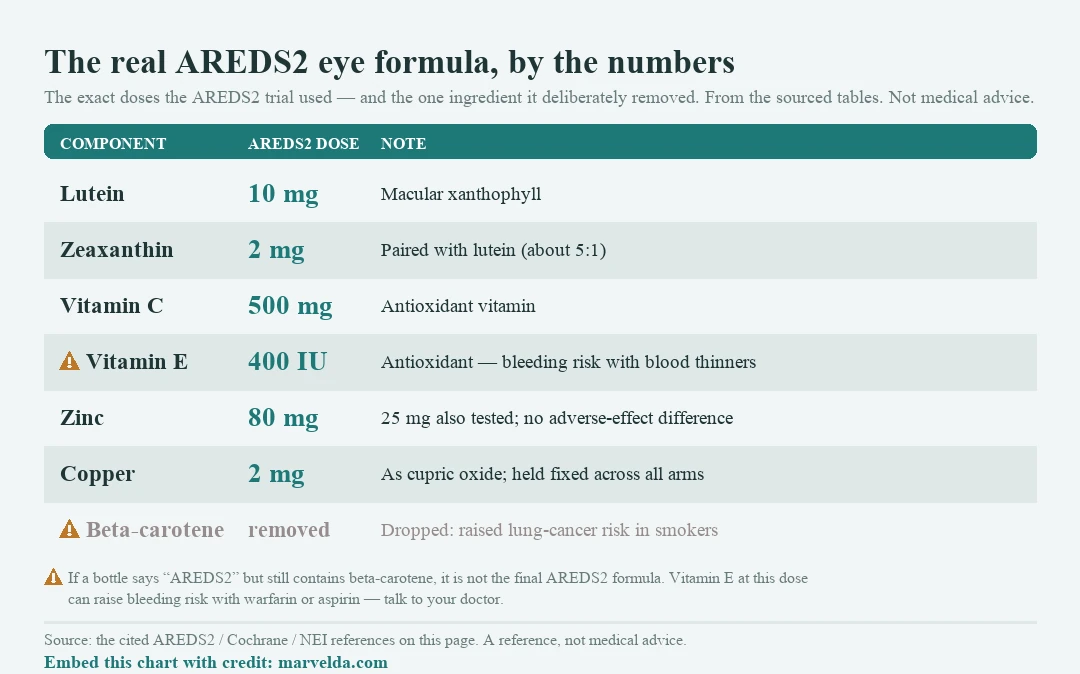
What the box won't tell you: the real AREDS2 formula is a specific recipe — 10 mg lutein, 2 mg zeaxanthin, 500 mg vitamin C, 400 IU vitamin E, 80 mg zinc, 2 mg copper — and it deliberately dropped beta-carotene after the data showed it raised lung-cancer risk in smokers and former smokers. If a bottle name-drops "AREDS2" but still lists beta-carotene, it isn't the final AREDS2 formula.
Macular Carotenoids and Xanthophylls
These three are the ones every "eye vitamin" bottle brags about on the front label, so they're where I always start when I'm comparing products — the table below is the version of these claims I actually trust, not the marketing copy.
| Ingredient | Classification | Primary Biological Role | Scientific Context |
|---|---|---|---|
| Lutein | Xanthophyll Carotenoid | One of three xanthophylls that concentrate in the retina, providing oxidant defense and filtering blue light (PubMed). | Included in the AREDS2 formula at 10 mg, paired with zeaxanthin at roughly a 5:1 ratio (PubMed). |
| Zeaxanthin | Xanthophyll Carotenoid | Concentrates with lutein and meso-zeaxanthin in the center of the retina; the combined buildup is measured as macular pigment optical density (MPOD) (PubMed). | Supplied in the AREDS2 formula at 2 mg alongside 10 mg of lutein (PubMed). |
| Meso-zeaxanthin | Xanthophyll Carotenoid | Not really a dietary nutrient on its own — it's converted from lutein inside the macula itself (PubMed). | Grouped with lutein and zeaxanthin as the three xanthophylls tracked via MPOD in eye-health research (PubMed). |
AREDS2 Formula Components
AREDS2 is the government-funded trial every "eye vitamins" product name-drops on the box, whether the actual formula matches the study or not (NEI). I keep these numbers in a note on my phone so I can check a label against the real thing before I order anything.
| Ingredient | Classification | Primary Biological Role | Scientific Context |
|---|---|---|---|
| Vitamin C | Water-soluble Vitamin | Classified as one of the antioxidant vitamins tested for slowing free-radical damage to retinal cells (Cochrane). | Used at 500 mg in both the original AREDS and AREDS2 formulas (PubMed). |
| Vitamin E | Fat-soluble Vitamin | Antioxidant vitamin included in the same formula, alongside vitamin C and zinc (Cochrane). | Used at 400 IU in AREDS2 — held unchanged across every zinc and beta-carotene test variation of the trial (PubMed). |
| Zinc | Essential Mineral | One of the minerals AREDS2 tested at two doses to see whether a lower amount held up (PubMed). | The original 80 mg dose was tested against a reduced 25 mg arm; a later Cochrane review found no difference between the two doses in adverse effects (Cochrane). |
| Copper | Essential Mineral | Held fixed at the same amount across every AREDS2 dosing arm, unlike zinc (PubMed). | Standardized at 2 mg, as cupric oxide (PubMed). |
Botanical Extracts and Fatty Acids
Everything past this point gets murkier — smaller trials, narrower populations, ingredients that show up on a label because they sound impressive rather than because the evidence is airtight. This is also where the supplement I regret buying lives.
| Ingredient | Classification | Primary Biological Role | Scientific Context |
|---|---|---|---|
| Bilberry Extract | Botanical (Anthocyanins) | Tested specifically against screen-related eye strain in one trial, separate from the older night-vision claim on most bottles (PubMed). | A 12-week trial of 240 mg/day found measurably less ciliary-muscle strain after screen tasks versus placebo (p = 0.014 and 0.017 at weeks 8 and 12) (PubMed). A separate systematic review found no support for the classic claim that it improves night vision in people with normal eyesight (PubMed). |
| Saffron Extract | Botanical (Crocins) | Studied in patients with early age-related macular degeneration, not in healthy screen users (PubMed). | A placebo-controlled trial using 20 mg/day over 3 months found improved retinal flicker sensitivity in early AMD — a small, single-site result the authors themselves said needs replication (PubMed). |
| Vitamin A | Retinoid / Beta-carotene | Required to build rhodopsin, the protein that lets your eyes adjust in low light (Healthline). | The beta-carotene form was dropped from the AREDS2 formula after data confirmed a higher lung cancer risk in smokers and former smokers (Cochrane). |
Last verified: 2026-07-12 — I went back through every row above and checked it against the actual paper instead of trusting my own notes from when I first built this table.
Quick disclaimer, since this is about what you put in your body: I'm a developer who logs his own eye fatigue in a spreadsheet, not an optometrist or any kind of doctor, and nothing here is medical advice — it's just the citation trail I build before I let myself click "buy." Talk to your own eye doctor before starting any of these, especially if you're already on a blood thinner: vitamin E at the 400 IU dose used in AREDS2-style formulas has been linked to a higher bleeding risk when combined with warfarin or aspirin (PubMed), which is exactly the kind of thing that never makes it onto the front of the bottle.
Sources
- Li X, et al. Potential roles of dietary zeaxanthin and lutein in macular health and function. Nutr Rev. 2023. (PubMed)
- AREDS2 Research Group. The Age-Related Eye Disease Study 2 (AREDS2): study design and baseline characteristics. Ophthalmology. 2012. (PubMed)
- Evans JR, Lawrenson JG. Antioxidant vitamin and mineral supplements for slowing the progression of age-related macular degeneration. Cochrane Database Syst Rev. 2023. (Cochrane via PubMed)
- National Eye Institute (NEI): Age-Related Eye Disease Studies (AREDS/AREDS2)
- Kosehira M, et al. A 12-Week-Long Intake of Bilberry Extract Improved Objective Findings of Ciliary Muscle Contraction of the Eye. Nutrients. 2020. (PubMed)
- Canter PH, Ernst E. Anthocyanosides of Vaccinium myrtillus (bilberry) for night vision — a systematic review. Surv Ophthalmol. 2004. (PubMed)
- Falsini B, et al. Influence of saffron supplementation on retinal flicker sensitivity in early age-related macular degeneration. Invest Ophthalmol Vis Sci. 2010. (PubMed)
- Healthline: Key Vitamins for Eye Health
- Kaye AD, et al. Vitamin E (α-Tocopherol): Emerging Clinical Role and Adverse Risks of Supplementation in Adults. Cureus. 2025. (PubMed)