
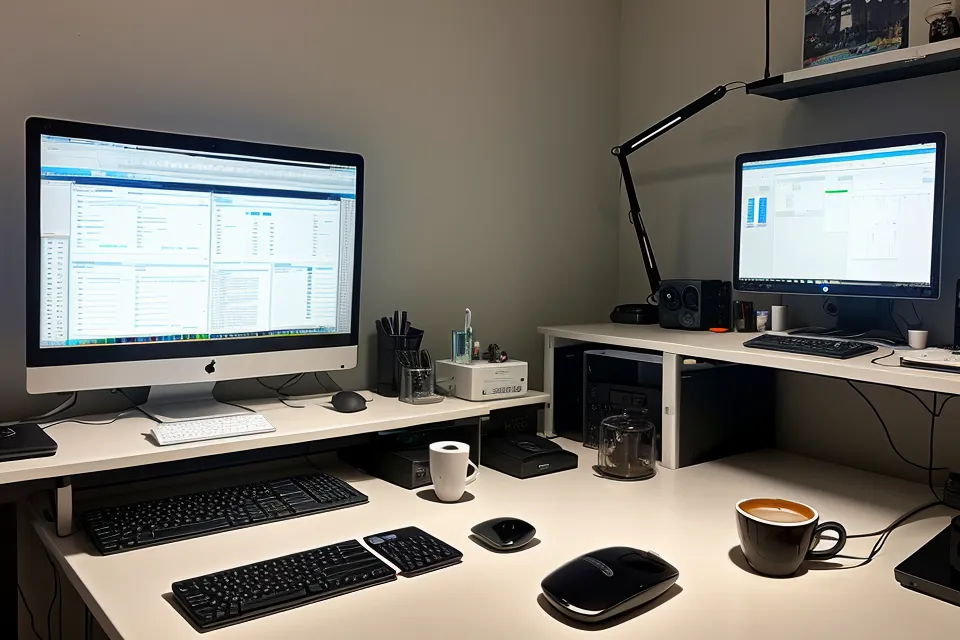
Cranking f.lux to its warmest amber setting all day fixes a monitor's color temperature — it does nothing for a retina that's spent eight or ten hours a day parked in front of three screens. I ran that software fix for weeks before admitting the problem wasn't the light coming off the glass, it was something further upstream that no color filter was going to touch.
None of what follows comes from a medical background. I build web applications for a living, not treatment plans, and the closest thing I have to credentials is a spreadsheet full of eye fatigue scores, supplement names, and dosage timing that I've kept going since my optometrist first used the phrase digital eye strain in an exam room. This site earns a commission on some of the links below, at no extra cost to you, and I only mention products I've actually logged results for.
Software Tweaks vs. the Real Digital Eye Strain Bottleneck
Blue light glasses were the other thing I tried before supplements ever entered the picture, and they're worth a mention here even though the fuller comparison against supplements lives in its own piece. My optometrist's actual diagnosis was computer vision syndrome, described to me as the occupational-hazard version of scanning three separate fields of text all day instead of one. Filters and tinted lenses address the light hitting the eye; they don't touch whatever was making my eyes feel depleted by mid-afternoon regardless of screen color temperature.
Monitor distance and room lighting are the baseline that has to be right before any capsule gets a fair test — I won't relitigate that setup here since it's covered in more depth elsewhere, but it's worth ruling out before spending money on a bottle at all.
Testing a Supplement Before I Trust It
Every formula gets logged the same way in my system before I'll say anything good or bad about it publicly — the actual method, what gets scored and on what scale, is its own writeup, but you can see the raw structure in my home office eye-tracking protocol if the spreadsheet itself is what you're after.
Brand-published clinical claims don't move me much until I've run the product myself for a stretch. A "clinically studied ingredient" on a label is marketing copy until it survives contact with an actual triple-monitor workday, and that skepticism toward manufacturer claims is a habit worth its own discussion beyond what fits here.
What's Actually Different Between These Formulas?
Ingredient count is the first thing most people compare, and it's the least useful metric on the label. A formula with two dozen ingredients isn't automatically stronger than one with twelve — in dependency terms, more packages in a project just means more surface area for something to conflict, not a better build.
Carotenoids like lutein and zeaxanthin show up in some ratio on nearly every eye formula, and the exact ratio between the two is a deeper rabbit hole than belongs in a buying guide — there's a full breakdown of that comparison elsewhere on this site for anyone who wants the specifics. What matters more day to day is whether a formula is actually processed well once it's in you, separate from how the ingredient list reads; bioavailability is the term for that gap, and two bottles with near-identical labels can feel completely different in practice because of it. I keep a running glossary of what these ingredient names actually are, since half of them sound like they belong in a chemistry set rather than a supplement aisle.
Budget, Middle Ground, or Premium: Picking a Lane
TheyaVue is the one to start with if you're not sure supplements will do anything for you at all — it's the cheapest of the three to try, the ingredient list runs long, and as an entry point for testing the waters it does the job without much commitment. What I noticed over my stretch with it was inconsistency more than failure: some weeks the mid-afternoon blur eased off noticeably, other weeks it didn't budge, and I never fully pinned down why.
iGenics sits in the middle — a tighter, twelve-ingredient formula that took longer to show anything and comes in a capsule size that's genuinely hard to swallow first thing in the morning. It's a reasonable middle ground if the budget option leaves you unconvinced but a premium price tag still feels early.
VisiFlora is where I landed as my daily pick, mainly because a single capsule fits a schedule already juggling client deadlines better than a multi-pill regimen does, and because the pattern held more consistently across weeks than the budget formula ever did. It costs more than the other two, and it's only sold through the official site rather than wherever you already buy vitamins, which is a real downside if convenience matters to you. If you've already tried adjusting your setup (I've got notes on brightness settings for triple-screen eye strain too) and you're still hitting a wall by early afternoon, this is the one I'd actually point you toward first.
| Product | Rating | |
|---|---|---|
| VisiFlora Top Pick | 9.4 | Read More → |
| iGenics | 8.8 | Read More → |
| TheyaVue | 8.1 | Read More → |
VisiFlora
Pros
- ✔ Unique gut-eye health connection actually worked for my fatigue
- ✔ Single capsule daily is perfect for a busy dev schedule
- ✔ Significant reduction in mid-afternoon screen ghosting
- ✔ Solid 60-day money-back guarantee policy
Cons
- ○ Higher price point compared to budget vitamins
- ○ Only available through the official site
Where Supplements Stop and Screen Habits Start
Dryness and fatigue get lumped together constantly, but they're not the same failure mode even when they show up in the same afternoon. Treating them as one problem is part of why generic fixes underperform. Supplement cycling is the other piece I haven't detailed here: I don't stay on one formula indefinitely, and rotating through options periodically is the only way I've found to tell whether a change in how my eyes feel is the product or just a lighter week of client work.
Twenty-twenty-twenty (glancing at something twenty feet away every twenty minutes) never left my routine, even after finding a supplement that actually helped; it's a floor, not a fix, and I still keep the timer running in a corner of a monitor. Some of my best afternoons now happen away from the three-screen rig entirely, laptop only, parked at a coffee spot along the South Congress strip, where the change of light and posture does something a capsule alone never could.
A six-hour sprint can run start to finish now with the eye drops still capped shut in my desk drawer, untouched — that's the marker I actually trust, more than any focus or clarity claim printed on a bottle. My friend Dex, a product manager I've known since college who went fully remote a couple of years back, is the only person in my circle who called his eye doctor before trying a supplement instead of after; everyone else I know, myself included, ordered the bottle first and asked questions later. Worth saying plainly: check with your own doctor before adding anything new, especially if you're already taking other medication, and don't treat a supplement as a substitute for an actual eye exam.
The Bottom Line for Triple-Monitor Setups
Three monitors and eight-plus hours a day is a workload eyes weren't really built for, and no single fix — software, hardware, or capsule — closes that gap alone. Start with TheyaVue if you want a low-cost way to see whether supplements move the needle for you at all. Step up to iGenics if the budget option felt inconclusive and a bigger capsule doesn't bother you. Reach for VisiFlora if you've already got the screen settings and rest habits sorted and you're still hitting a wall most afternoons — it's the one that's held up longest in my own rotation, and the simplicity of a single daily capsule is worth the higher price tag for anyone juggling as many browser tabs as I do, which is a number I'd rather not admit to a doctor.